Hearing the garage door opener run without seeing normal door movement does not identify one failed part. The opener may not be connected to the door, its drive or trolley may not be transferring motion, or the door may be too heavy or restricted because of a spring, cable, track, roller, or section problem. Repeated cycles can add damage, so the first goal is to observe safely and stop testing when the door is unstable.
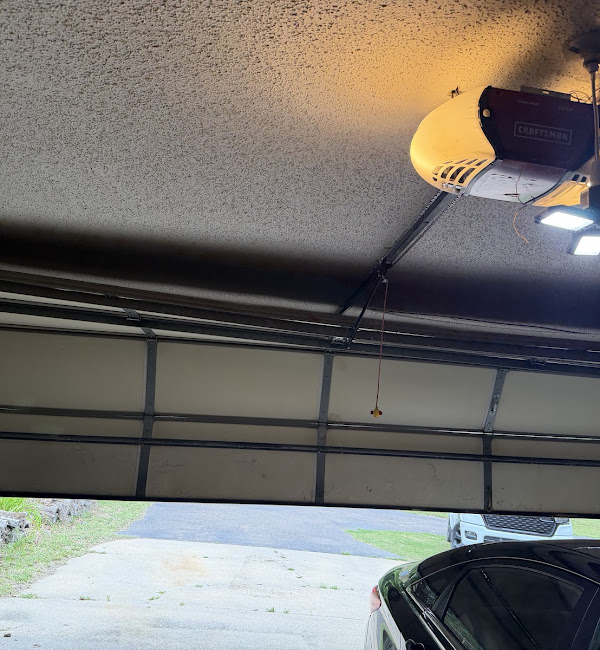
Stop repeated opener cycles and watch one safe attempt
Stand clear of the opening and keep the moving door in view. Note whether the opener light turns on, the motor sounds normal, the rail or drive moves, the trolley travels, and the door moves at all. Also note whether the door is fully closed, partly open, crooked, or unusually noisy.
Stop immediately if the door tilts, a cable hangs loose, a roller leaves the track, a section bends, the opener rail moves, or the door drops or rises unexpectedly. Do not stand under a partly open door and do not keep pressing the control to force movement.
The opener may be disconnected from the door
Many openers use a trolley and emergency-release mechanism that allows the door to be separated from the opener for manual operation. If the release has been activated, the motor and drive may run while the door remains in place. A trolley or connecting arm can also be damaged or out of position.
Do not pull the emergency release when the door is open, crooked, unusually heavy, off track, or showing a loose cable or spring problem. Disconnecting the opener does not make an unstable door safe, and it can remove the only connection limiting unexpected movement.
A drive or internal opener part may not transfer motion
Depending on the opener design, motion may be transferred through a chain, belt, screw, rail assembly, trolley, sprocket, gear, or other internal parts. A motor sound without normal trolley movement can point toward the drive path rather than the door controls.
Record what moves and what remains still, but do not remove the opener cover or reach near moving parts. The model number and indicator-light pattern can help identify the correct service information without opening the unit.
The door may be too heavy or restricted for the opener
An opener is designed to move a properly balanced door. It should not supply the lifting force that a spring system is meant to provide. A broken spring, incorrect balance, displaced cable, binding roller, bent track, damaged section, or locked door can make the opener strain, stop, or move without lifting the door normally.
- A visible gap in a torsion spring can indicate a broken spring.
- A loose or crossed cable can allow one side of the door to move differently.
- A roller near or outside the track can make the door bind.
- A manual lock or obstruction can prevent movement while the opener continues trying.
- A bowed section or loose hinge can change the door path under load.
Do not increase opener force to overpower these conditions. Additional force can hide the symptom while placing more load on the opener attachment, door sections, and lifting hardware.
Safe checks that do not require disassembly
Compare the wall control, remote, and keypad
If the motor runs from one control but not another, the control, battery, programming, signal, or lock mode may be involved. If the motor runs consistently but the door does not move, focus the service description on the trolley, drive, connection, and door condition.
Look for an obvious manual lock or obstruction
From outside the door path, check for a slide lock, stored item, ice, debris, or another visible obstruction. Do not reach into tracks or loaded hardware. Stop if an object is caught where removing it could release door movement.
Record the door position and visible hardware
Wide photographs from a safe distance can show the door position, tracks, opener rail, spring area, and cable condition. Include the opener model label only if it can be photographed without climbing or entering the door path.
What not to adjust
Do not turn spring winding hardware, loosen a bottom bracket, rotate a cable drum, pull a loaded cable, bend a track, or remove the opener-to-door connection from an unstable door. Do not change force or travel repeatedly when the door has not been shown to move freely and remain balanced.
The DASMA garage door system safety guidance emphasizes model-specific instructions and identifies springs as a particularly important and dangerous part of the door system. Loaded lifting hardware should be evaluated by a trained door systems technician.
What a complete opener diagnosis should include
A useful inspection separates the control signal, opener drive, trolley connection, and door mechanics instead of replacing parts by guesswork. The review may include power, wall and remote controls, lock mode, indicator codes, rail, belt or chain condition, sprocket or gear movement, trolley, connecting arm, opener mounting, and door reinforcement.
The door itself should also be evaluated for spring condition, cable tracking, drums, balance, tracks, rollers, hinges, sections, locks, and manual movement when it is safe to disconnect. After the cause is corrected, the completed system should be tested for controlled travel, force, photo-eye operation, reversal, controls, and manual release.
Repair the opener or replace it?
The decision depends on the failed component, opener age and condition, parts availability, safety-device compatibility, door weight, rail and mounting condition, desired controls, and the condition of the door itself. A new opener will not correct a broken spring, loose cable, bent track, or poorly balanced door.
Compare the complete installed result. If the existing opener can be repaired safely and remains compatible with the door, repair may be practical. If major components, controls, or safety systems are no longer suitable, replacement may deserve comparison after the door is confirmed to operate correctly.
Safety reversal remains part of the final test
The U.S. Consumer Product Safety Commission states that automatic residential garage door operators are covered by the federal safety standard in 16 CFR Part 1211. After opener work, entrapment protection and reversal should be tested according to the manufacturer instructions, with the door path clear and the moving door kept in sight.
Do not bypass photo eyes or rely on a repaired motor sound as proof that the system is safe. Correct door movement and safety response must be verified together.
Frequently asked questions
Why does the opener run after I pulled the emergency release?
The release can separate the trolley connection so the opener moves without carrying the door. Do not reconnect or pull the release again if the door is open, crooked, unusually heavy, or showing a spring or cable problem.
Can I increase the force so the opener lifts the door?
Do not use force adjustment to overcome a heavy, unbalanced, locked, or restricted door. The springs, cables, tracks, rollers, sections, and opener connection should be checked first.
Does a running motor mean the opener needs replacement?
No. The symptom can involve the release, trolley, drive system, opener mounting, door balance, springs, cables, tracks, locks, or another restriction. Diagnosis should identify where motion stops before repair or replacement is selected.
For service in Edmond and MTA’s confirmed metro areas, review the garage door opener repair page, compare spring warning signs, and use the 24/7 garage door repair page when the opening cannot be secured or the door is unstable. You can also request an opener and door-system inspection.