
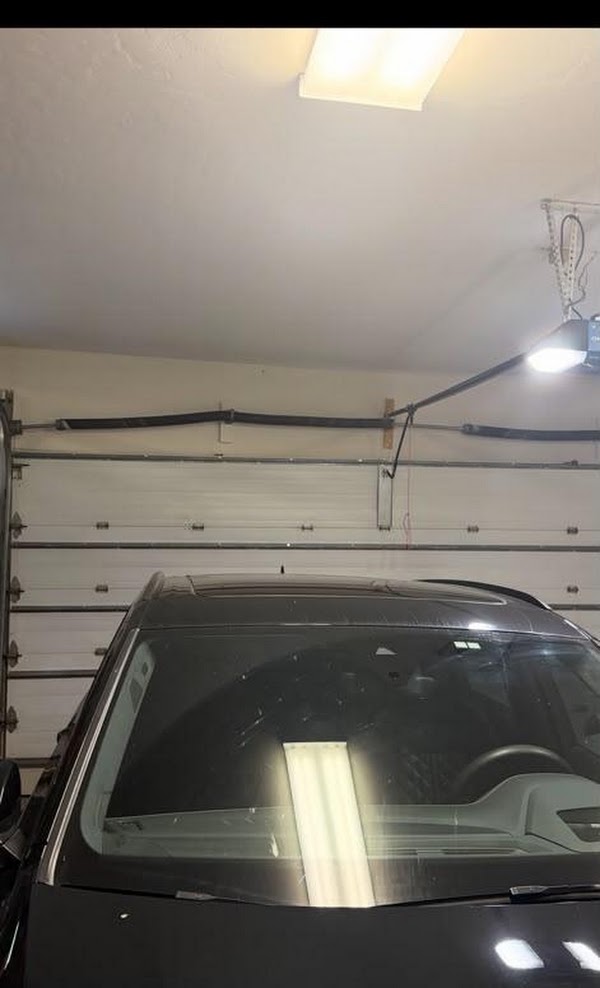
What the cable and drum do
On many sectional garage doors, a cable is attached near the bottom of each side of the door and winds around a drum above the opening. The spring system supplies lifting force while the drums guide the cables so both sides rise together. The opener should move a properly balanced door; it should not replace the lifting force of the spring system.
If one cable loses tension, the opposite side may continue carrying load. That difference can pull the door at an angle, move a roller toward the edge of its track, or allow the cable to cross and bind on the drum.
Warning signs of a cable or lifting-system problem
- One cable hangs loose while the cable on the other side remains tight.
- The door rises higher on one side or rests at an angle.
- Wire strands look frayed, kinked, rusted, or separated.
- A cable is crossed, stacked unevenly, or outside the grooves of the drum.
- The opener lifts the door a few inches, strains, or stops.
- A roller approaches the track edge after the cable tension changes.
Stop operating the door if any of these signs appear. Keep people, pets, and vehicles away from the opening, especially when the door is partly open.
Why a garage door cable can come off the drum
A spring or balance problem
A broken spring, incorrect spring tension, or another balance problem can remove the force that keeps the lifting system controlled. The cable may become slack as the door changes position. Reinstalling the cable without resolving the balance problem does not address the cause.
An obstruction or uneven door position
If one side of the door meets an object or binds while the other side continues moving, cable tension can change quickly. A crooked door, damaged section, or roller problem can create the same pattern.
Track, roller, or drum movement
Loose or shifted hardware can change the path of the door or cable. The drum, shaft, tracks, rollers, and bearing supports should be considered together rather than assuming the visible cable is the only failed part.
Cable wear or damage
Individual wire strands can wear near attachment points and areas of repeated bending. Fraying, corrosion, flattening, or kinks can reduce cable strength. A visibly damaged cable should not be reused simply because it can be placed back on the drum.
What not to touch
Do not loosen a bottom bracket, turn a cable drum, pull a loaded cable, or adjust a spring. These components can carry substantial force even when the door is not moving. Do not stand beneath a partly open door or use the opener repeatedly to try to straighten it.
Safe information to collect includes the current door position, which side is higher, whether a spring gap is visible, and wide photographs taken from a clear distance. Do not move closer to loaded hardware just to take a picture.
What a cable service visit should evaluate
A useful inspection should identify why tension changed before the door returns to service. The review may include cable condition, drums, bottom brackets, springs, shaft supports, door balance, tracks, rollers, section alignment, opener connection, travel, and safety reversal.
Depending on what is found, the work may involve replacing a damaged cable, restoring correct cable tracking, correcting another lifting component, or addressing a door or track condition that caused the cable to lose tension. Final testing should confirm even movement and controlled balance.
Frequently asked questions
Can I put the cable back on the drum myself?
Do not reposition a cable or rotate a drum while the lifting system is loaded. A displaced cable may be the result of a spring, balance, track, roller, or door-position problem that also needs correction.
Why is only one cable loose?
The door may be uneven, one side may have encountered resistance, or tension may have changed at a drum, spring, or cable attachment point. Both sides and the complete lifting system should be checked.
Can the opener keep the door in place?
The opener is not a safety support for a door with a lifting-system problem. Keep clear of a partly open or crooked door and request service.
What to tell the technician before a cable-repair visit
A clear description helps the team plan the inspection without asking you to operate an unsafe door. From a safe position, share what you already observed:
- Is the door fully closed, partly open, or crooked? Mention whether the opening can be secured.
- Which side appears lower, and is there a loose or visibly damaged cable?
- Was there a loud bang, an obstruction, an impact, or uneven movement before you stopped using it?
- Is a vehicle trapped, and is there another way to enter the property?
- Can you provide an existing wide photo without approaching or standing beneath the door?
You do not need to determine the failed part before calling. Do not cycle the opener again, pull on a cable, release a suspended door or move closer to loaded hardware to collect this information. Confirm the service address and visit arrangements directly.
Choose the correct branch in our MTA locations directory. For a property served by Warr Acres, use the Warr Acres track and lifting-system service page; its direct contact is separate from Edmond.
Homeowners and property managers in Edmond and MTA’s confirmed Oklahoma City metro service areas can review the garage door cable repair service, spring repair guidance, and off-track door service. If the door is unstable or cannot secure the opening, use the 24/7 garage door repair page.