Start by noticing where and how the door stopped
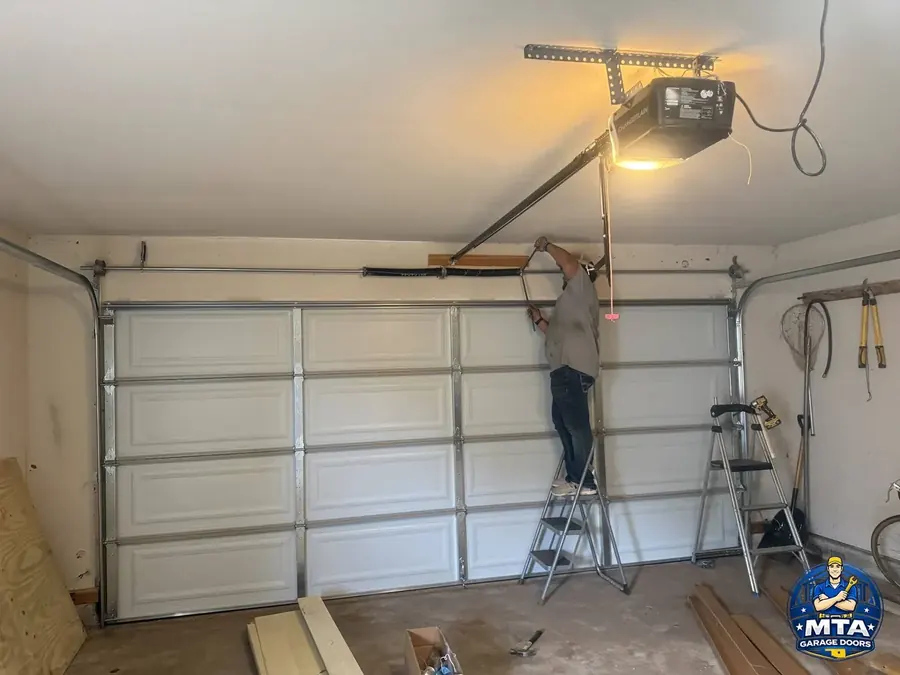
The stopping point and movement pattern are useful clues. Note whether the door started from the floor or from the open position, whether the opener motor continued running, whether one side moved farther than the other, and whether the door stopped at the same point on a second command. Do not perform repeated cycles to collect more information. One careful observation is enough when the door moves unevenly or loaded hardware looks abnormal.
If the door is partly open, do not stand, park, or place equipment beneath it. Keep children and pets away from the opening. A door that has lost spring or cable support can move unexpectedly, and the opener is not a safety support.
A broken spring can leave the door too heavy to travel
The spring system supplies most of the lifting force needed to move the door. When a torsion spring breaks, a visible gap may appear in the spring above the opening. An extension spring may separate or lose tension along one side. The opener may raise the door only a short distance, stop under load, or make the door appear to be stuck halfway.
Do not pull, turn, stretch, or reconnect a spring. Do not increase opener force to compensate for a heavy door. Spring selection and adjustment depend on the door weight, hardware, dimensions, and complete lifting configuration. Review the garage door spring warning signs if a loud bang, visible gap, or sudden change in door weight happened before the problem.
Loose or uneven cables can make the door stop crooked
Cables and drums help both sides of a sectional door move together. A loose, crossed, frayed, or displaced cable can let one side rise while the other side remains lower. The door may bind in the tracks or a roller may approach the edge of its track. A cable problem can also be a symptom of a spring, balance, obstruction, or door-position problem.
Keep clear of bottom brackets, drums, shafts, and loaded cables. Do not attempt to place a cable back on a drum or straighten the door with the opener. The cable-off-drum guide explains why the complete lifting system should be checked before a cable is repositioned or replaced.
Tracks and rollers can create resistance at one point
A shifted track, damaged roller, loose hinge, debris, or a bent section can create resistance as the door reaches a particular height. Look from outside the track path for a roller that is out of position, a track that has moved, a hinge pulling away, or a section that changes shape while moving. Do not place fingers inside a track or between door sections.
Remove only an ordinary loose object that can be reached without going under the door or touching loaded hardware. Leave anything caught in a cable, bracket, roller, hinge, or spring system in place until the door is made safe. If the door grinds, tilts, or jerks, use the track and roller repair page rather than continuing to cycle it.
A damaged panel or hinge can bind during travel
Door sections change angle as they pass through the curved track. A dent or bow that looks minor while the door is closed may interfere with a hinge, roller, reinforcement strut, or adjoining section during travel. Watch from a clear location for a section that flexes, rubs, separates, or pulls away from its hardware.
Do not push, hammer, or brace a connected section while the door is partly open. Hardware attached to the moving door may be loaded, and changing the shape of one section can affect track alignment and balance. Compare the visible condition with the panel repair or replacement guide.
The opener may stop even when the door hardware looks normal
If the door remains level and stable, the opener side of the system may need diagnosis. Travel settings, force response, an overheated motor, a worn trolley, a slipping drive component, a manual lock, a partially engaged release, or an electrical or control fault can interrupt movement. Indicator lights, beeps, motor sounds, and whether the rail or trolley moves are useful details to record.
Do not remove the opener cover, touch electrical parts, or increase force to push through resistance. The opener should move a correctly balanced door; it should not overpower a spring, cable, track, panel, or lock problem. If the motor runs but the door does not move, use the opener-runs-without-door-movement guide.
Photo eyes usually affect closing, not opening
When a door stops or reverses while closing, the photo-eye safety circuit may be involved. Check for an ordinary obstruction, a dirty lens, a shifted bracket, visible wire damage, or an inconsistent indicator light from outside the door path. Do not tape over, bypass, or relocate a safety sensor.
If the door stops while opening, photo eyes are less likely to explain the symptom by themselves. Door resistance, balance, opener travel, controls, or another mechanical condition should be considered. The direction of travel is therefore important when describing the problem.
Do not pull the emergency release without checking door condition
The manual release disconnects the opener from the door; it does not make a heavy or unstable door safe. Do not pull it while the door is open, crooked, off track, supported unevenly, or showing a loose cable or spring problem. Disconnecting the opener in those conditions may allow uncontrolled movement.
If the door is fully closed, level, stable, and free of visible lifting-system damage, the manufacturer instructions may describe a manual-operation check. Stop if the door feels unusually heavy, will not stay controlled, or binds. Do not attempt to hold a heavy door in position by yourself.
Information that helps diagnose a halfway stop
- Direction: Did the door stop while opening or closing?
- Position: Did it stop at the same height each time, or did one side stop first?
- Movement: Was the travel smooth, jerky, crooked, or unusually fast?
- Sound: Was there a bang, scrape, pop, hum, click, or grinding noise?
- Visible hardware: Is there a spring gap, loose cable, displaced roller, bent track, damaged hinge, or bowed section?
- Opener response: Did the motor, trolley, rail, lights, and controls behave normally?
Wide photographs taken from a safe location can document door position and visible hardware. Do not move beneath the door, climb near loaded parts, or share keypad codes and access credentials.
What a complete service inspection should cover
A useful diagnosis should review door balance, springs, cables, drums, bottom fixtures, rollers, tracks, hinges, sections, reinforcement, seals, manual locks, opener attachment, rail, trolley, drive system, travel, force response, controls, photo eyes, and safety reversal. The goal is to identify the cause of the stopping point rather than adjusting the opener until the symptom disappears.
After the cause is corrected, testing should confirm level travel, controlled balance, clear track movement, correct cable tracking, secure hardware, suitable opener connection, proper limits, and working entrapment protection. The opening should be kept clear during every test.
Frequently asked questions
Can I keep using the opener if the door stops halfway?
Do not keep cycling it. Repeated operation can add load to a spring, cable, track, roller, panel, or opener problem and may move an unstable door into a more dangerous position.
Why does the door stop at the same place every time?
A repeated stopping point may involve travel setup, track resistance, a damaged roller or section, a rail or trolley issue, or another condition that appears at that position. The door and opener should be evaluated together.
Can I close a stuck door by hand?
Do not release or move a partly open door that is crooked, unusually heavy, off track, or showing spring or cable damage. A stable closed door is safer than an unsupported open door, but the correct procedure depends on the actual door condition and manufacturer instructions.
Is a halfway stop always an opener problem?
No. The opener may be reacting correctly to a heavy, unbalanced, obstructed, or binding door. Springs, cables, tracks, rollers, hinges, panels, locks, and the opener all need to be considered.
For a garage door stuck halfway in Edmond or MTA’s confirmed Oklahoma City metro service areas, use the 24/7 garage door repair page when the opening cannot be secured or the door is unstable. For a controlled non-emergency problem, request a complete door-and-opener inspection or call (405) 554-3770.