
Not every garage door symptom has the same urgency. A cosmetic dent or remote-control battery can often wait for a scheduled visit, while a crooked door, broken lifting component, uncontrolled movement, or an opening that cannot be secured deserves immediate attention. This guide helps Edmond homeowners describe what they can see, avoid dangerous adjustments, and choose the appropriate next step.
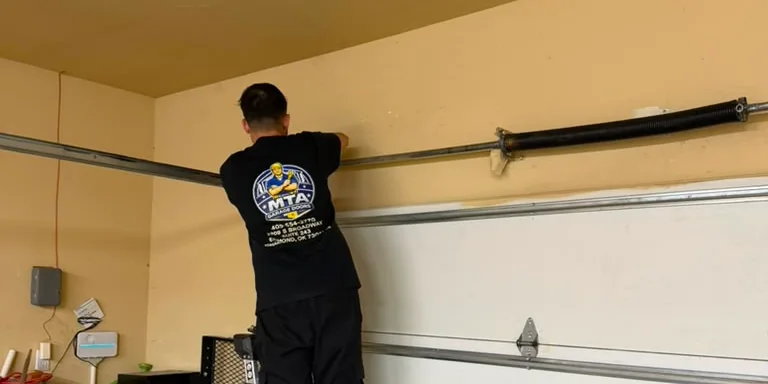
Call promptly when the door is unstable or the opening is not secure
A garage door problem becomes urgent when continued operation could cause uncontrolled movement, additional damage, or leave the home exposed. The safest first step is usually to stop using the wall control and remote, keep people and vehicles away from the opening, and look from a distance. Do not stand beneath a partly open door while deciding what to do.
When contacting MTA Garage Doors, explain whether the door is open or closed, level or crooked, connected to the opener, and able to secure the opening. Mention any bang, grinding sound, impact, loose cable, visible spring gap, roller outside the track, or unexpected movement. Those observations help identify the type of inspection needed without asking you to touch loaded hardware.
1. The garage door is crooked, off track, or partly hanging
A door that is visibly tilted, has a roller outside the track, or hangs differently on one side should not be cycled again. The condition can involve tracks, rollers, hinges, cables, drums, springs, or damaged sections. Continuing to operate the opener may pull the door farther out of alignment or place additional load on the remaining hardware.
Do not try to push a roller into the track, bend the track, loosen brackets, or pull the emergency release. A crooked door may shift when its connection to the opener changes. Keep the area clear and request an off-track garage door inspection.
2. A spring appears broken or the door suddenly feels heavy
A sudden bang followed by a door that lifts only a few inches, feels unusually heavy, or has a visible separation in a torsion spring can indicate a spring-system problem. Springs provide much of the lifting force needed to balance the door. The opener should not be used to compensate for a spring that is no longer carrying its share of the load.
Do not wind, cut, loosen, or touch the spring, winding cones, center bracket, cable drums, bottom brackets, or cables. These components can store or transfer substantial force even when the door is stationary. Review the garage door spring repair page and arrange a professional evaluation.
3. A cable is loose, crossed, frayed, or off the drum
Lift cables help transfer spring force to the door. If a cable hangs loose, leaves a drum, crosses over itself, or appears damaged, one side of the door may no longer be supported or may move differently from the other. Do not pull the cable or try to place it back on the drum.
Stop operation even if the door still moves. Photograph the overall door position from a safe distance and describe which side looks different. The cable-off-drum warning guide explains useful observations, and the garage door cable repair page covers the matching service.
4. The door falls, jerks, or moves unpredictably
A door that drops, accelerates, jerks, or will not remain in a stable position can create a serious path-of-travel hazard. The cause may involve balance, springs, cables, tracks, rollers, hinges, opener settings, controls, or more than one component. Do not walk or drive beneath the door and do not attempt a manual balance test while the door is unstable.
Keep children, pets, and vehicles outside the movement area. If the door is already closed, leave it closed. If it is open or partly open, do not place objects or body parts beneath it in an attempt to support it.
5. The door will not close and the property cannot be secured
A door that remains open can create an access and security problem. First check only what can be observed safely: whether an object blocks the opening, whether the photo-eye lenses are visibly obstructed, and whether a manual lock is engaged. Do not bypass photo eyes, repeatedly increase opener force, or hold a control to force a visibly damaged door closed.
If the door is level and stable but reverses near the floor, the issue may involve sensors, travel, force, resistance, or a door-mechanics problem. Use the garage door will not close guide for safe observations. If the opening cannot be secured, treat the problem as urgent and call for service.
6. The opener strains, the rail moves, or the motor runs without normal door travel
An opener can sound active even when motion is not reaching the door. The trolley may be disconnected, the drive system may have a fault, or the door may be too heavy or restricted because of a spring, cable, track, roller, lock, or section problem. Repeated cycles can add load to the opener rail, attachment point, and door.
Do not remove the opener cover or increase force to overpower a heavy door. Note what moves and what remains still, then review the guide for an opener that runs without moving the door or the garage door opener repair page.
7. An impact damaged the door, tracks, or hardware
Vehicle contact or another impact can affect more than the visible dent. A section may bow, a hinge can loosen, a roller can move out of position, a track can shift, or the door may no longer travel evenly. Stop using the door if sections separate, hardware pulls away, the door rubs or binds, or the opening cannot be secured.
A small cosmetic dent in a stable door may be scheduled normally, but structural movement should be evaluated before another cycle. Compare the panel repair-or-replacement guide and the matching panel service options.
8. You notice smoke, burning odor, heat, or electrical arcing
Stop using the opener. If power can be disconnected without approaching heat, smoke, exposed wiring, or a moving door, disconnect it according to the equipment instructions. Do not open the motor housing or touch damaged wiring. If there is active fire, visible arcing, or an immediate electrical hazard, leave the area and contact emergency services or the appropriate utility before garage door service.
After the immediate electrical hazard is addressed, the opener, outlet, wiring, controls, door balance, and mechanical resistance should be evaluated together. A strained opener may be a symptom of a door problem rather than the only failed component.
Problems that can often be scheduled instead of treated as emergencies
Some issues can usually wait for a normal appointment when the door remains level, stable, fully secured, and free of loose loaded hardware. Examples may include a remote battery that needs replacement, a cosmetic surface mark, a worn weather seal, mild new noise, a light that no longer turns on, or a planned maintenance inspection.
Conditions can change, so stop operation if the symptom becomes more severe, movement turns uneven, the door becomes heavy, a cable loosens, or the opening will not secure. A non-urgent issue should still be scheduled when it affects reliable operation or safety testing.
What to do before the technician arrives
- Stop repeated operation. Leave a stable closed door closed and do not test an unstable open door.
- Clear the area. Keep people, pets, vehicles, and stored items away from the door path.
- Observe from a safe distance. Note the door position, visible gaps, loose cables, displaced rollers, damaged sections, opener behavior, and sounds.
- Share wide photos. Photograph the complete interior door, tracks, spring area, and opener only when this can be done without climbing or standing beneath the door.
- Explain access and security. Tell MTA whether a vehicle is trapped, the opening is exposed, or another entrance is available.
The Door and Access Systems Manufacturers Association garage door safety guidance recommends following the manufacturer instructions and treating springs and related lifting hardware with particular caution. Automatic opener safety devices and reversal should be tested only with the door path clear and according to the specific manufacturer procedure.
Frequently asked questions
Is a garage door that is stuck open an emergency?
It can be urgent when the opening cannot be secured, the door is crooked or unstable, or people and vehicles cannot use the area safely. Keep clear of the door and describe its position when you call.
Should I pull the emergency release if the door will not move?
Do not pull it when the door is open, crooked, unusually heavy, off track, or showing a loose cable or spring problem. Disconnecting the opener can allow an unsupported door to move unexpectedly.
Can I close a door manually after a spring breaks?
Do not attempt to lift or lower a door with a suspected broken spring. The door can be much heavier than expected, and cables or other components may also be displaced.
For an unstable or unsecured door in Edmond or a confirmed Oklahoma City metro service area, use MTA’s 24/7 garage door repair page or request service online. Call (405) 554-3770 and describe the door position and visible warning signs.